

Insights
Why room pricing should change with demand
A plain-English case for dynamic pricing over static rates — and why a fixed price quietly costs independent hotels money on both busy and quiet nights.
Most independent hotels still sell tomorrow’s rooms at much the same price they sold last month’s. It feels orderly. It is easy to explain to the team, easy to load into the system, and easy to defend to a guest at the desk. Yet a single fixed rate quietly assumes that every night carries the same value — and almost no night does. The same room is worth more during a regional conference than it is on a wet Tuesday in low season, and a price that ignores that difference leaves money on the table in both directions.
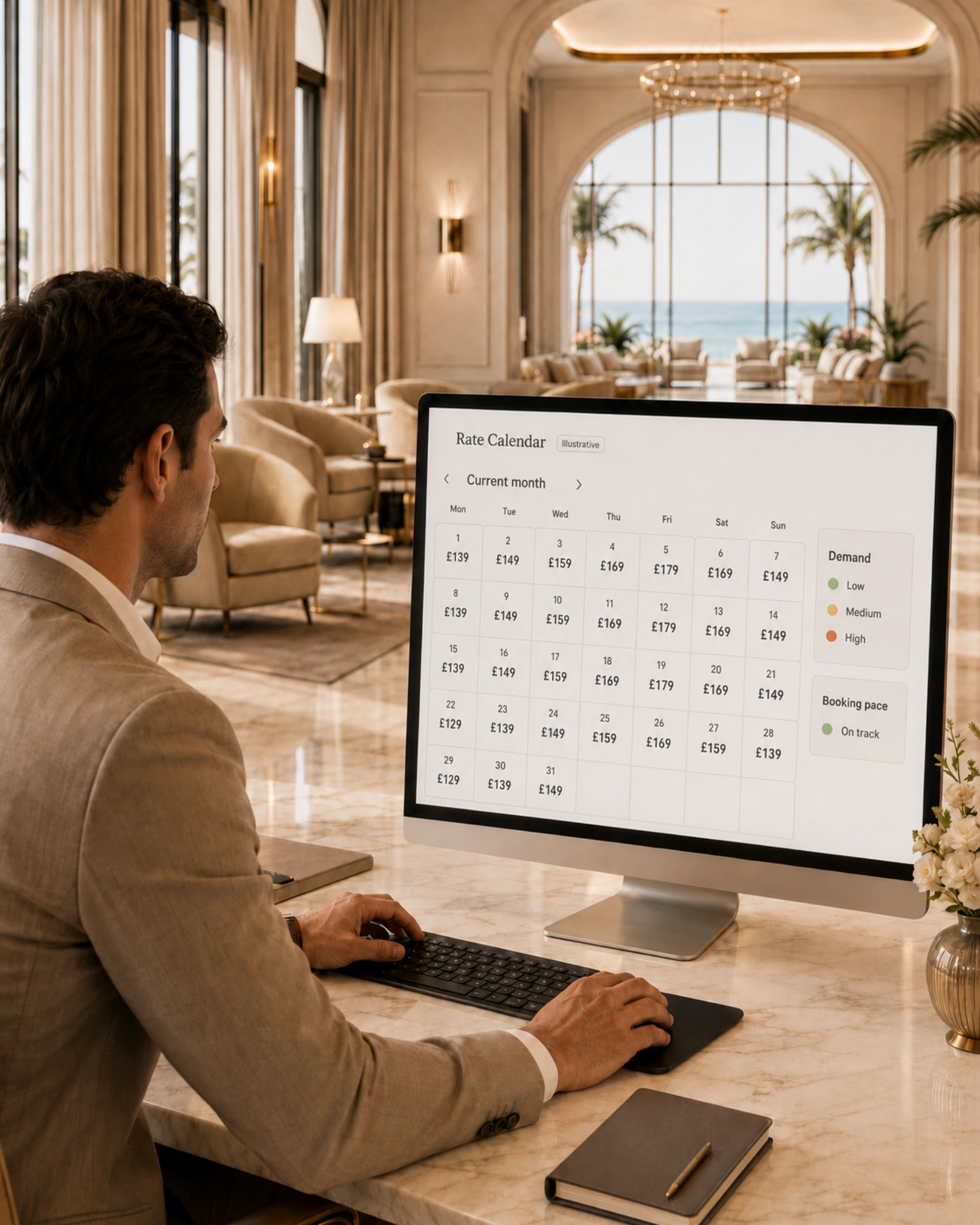
Dynamic pricing is simply the practice of letting your rates move with the value of the night. It is not about chasing competitors or discounting in a panic. Done well, it is a calm, evidence-led discipline: read the signals, set the price the night deserves, and review the result. Below, we set out the ideas in plain English and show why static rates tend to cost more than they save.
The signals that should move your price
A handful of factors tell you what a given night is really worth. None of them is complicated once named.
- Demand. How many people want a room in your area on that date. High demand pushes value up; soft demand pulls it down.
- Lead time. How far ahead the booking is made. Patterns in early versus last-minute bookings reveal how confident you can be about filling the night, and when to hold firm or soften.
- Seasonality. The predictable rhythm of your year — school holidays, events, weather, regional trade. Much of this is foreseeable months ahead.
- Comp-set. Your competitive set: the small group of nearby properties a guest would realistically choose between. Where your rate sits relative to theirs shapes whether you win the booking and at what value.
- Rate parity. Consistency of your published rate across the channels you sell on, so the same room is not quietly cheaper somewhere you do not control. Parity protects your direct relationships and your perceived value.
A static rate treats every one of these as fixed. Dynamic pricing treats them as the live inputs they actually are.
How a fixed rate costs you on a busy night
Picture a strong night — an event in town, the comp-set filling fast, demand clearly outstripping supply. A hotel on a fixed rate sells out early and feels pleased. But selling out early is rarely a triumph; it is usually a sign the price was too low. Those rooms were worth more than the guest was asked to pay, and that gap never returns.
This is underpricing, and it is the most expensive mistake in revenue management precisely because it feels like success. The hotel sees full occupancy and assumes it has won. In reality, average daily rate (ADR) sat below what the market would happily have borne, and revenue per available room (RevPAR) — the figure that actually reflects how well each room earned — came in lower than it needed to. On the nights you can least afford to leave value behind, a fixed rate almost guarantees you will.
How a fixed rate costs you on a quiet night
Now the opposite. A soft midweek night in shoulder season, the comp-set discounting, demand thin. The hotel holds its standard rate out of principle — and the rooms stay empty. An unsold room earns nothing and cannot be recovered; tonight’s empty room is gone for good at midnight.
Here the fixed rate is too high for the night’s value, and overpricing simply hands the booking to a more responsive neighbour. A modest, deliberate adjustment might have captured a guest who then spends in the bar, the restaurant or the spa. Holding firm protected a number on a rate sheet while the real number — RevPAR across the month — quietly slipped.
Dynamic does not mean reckless
It is worth saying clearly: moving your rates is not the same as discounting, and it certainly is not a race to the bottom. The aim is to charge the right price for each night’s value — higher when the night earns it, more competitive when it does not. The discipline matters more than the direction.
- Anchor decisions in your own booking data, not gut feeling alone.
- Watch lead time so you act early on strong dates and stay patient on soft ones.
- Keep an eye on the comp-set without blindly following it.
- Protect rate parity so your direct channel is never the most expensive door.
Independent properties are often better placed for this than the chains. You know your market, your repeat guests and your local calendar intimately. With a clear method, that knowledge becomes a genuine commercial edge rather than a fixed price that ignores it.
Where to begin
If your rates have looked broadly the same for months, the first step is not a new system—it is an honest look at what your nights are worth and where value is leaking. During partnership onboarding, demand patterns, lead times, seasonality and comp-set position form part of the commercial baseline. Any target remains subject to the hotel data, market conditions and implementation.
If you would like to understand where pricing may be quietly costing you—and put a disciplined rate rhythm in place—discuss the Growth partnership.
The figures and ranges in this article are illustrative. Actual results depend on each property’s data, market conditions and implementation. The best way to understand your own opportunity is a senior conversation about the partnership depth your property needs.