

Insights
Reservations management mistakes that reduce revenue
The everyday reservations errors that quietly drain revenue at small hotels — and the practical fixes that protect every booking.
Most independent hotels do not lose money on the nights that go wrong. They lose it on the ordinary days, through small reservations habits that look harmless in isolation and add up to a meaningful gap by the end of the quarter. A virtual card charged a day late. A cancellation deadline that slipped past unnoticed. An online travel agency message that sat unread until the guest had already booked elsewhere.
None of these feels like a crisis in the moment. That is precisely why they persist. The reservations desk is busy, the team is stretched across arrivals and enquiries, and the quiet revenue leaks rarely announce themselves. Below are the mistakes we see most often at smaller properties, the revenue impact behind each, and the discipline that closes the gap.
Virtual cards charged late, or not at all
Virtual credit cards from OTAs and intermediaries are now a routine part of how bookings settle. They are also one of the most common sources of lost revenue, because each card carries its own activation date, charge window and value. Miss the window, and the funds may no longer be available. Charge the wrong amount, and reconciliation becomes a slow, error-prone chase.
The damage is rarely a single large hit. It is a steady trickle of partial charges, expired cards and write-offs that never make it onto anyone’s radar.
The fix is process, not effort:
- A daily checklist of virtual cards due to be charged, sorted by activation date
- A clear rule on the exact amount and timing for each channel
- A reconciliation step that flags any card not charged within its window
When this is handled consistently, the trickle stops. Outsourced reservations management exists in large part to make this kind of routine non-negotiable, rather than dependent on whoever is on shift.
Cancellation deadlines that quietly pass
Flexible and non-refundable rates only protect revenue if the rules behind them are actually applied. At many small hotels, cancellation deadlines are tracked loosely, and the cut-off for charging a no-show or late cancellation is missed. The booking falls away, the room sits empty, and no charge is raised because nobody noticed the deadline arrive.
This is one of the clearest examples of revenue that was contractually owed and simply not collected. The policy was sound. The follow-through was not.
A reliable approach treats every cancellation window as a dated action, not a passive note in the system. Deadlines are monitored, charges are raised promptly where the rate allows, and the team can show exactly why each decision was made. Done well, this also reduces disputes, because the guest is dealt with in line with the terms they agreed to.
OTA messages left unanswered
Online travel agencies increasingly reward responsiveness. A prospective guest sends a question through the platform, and the speed and quality of the reply influences both the booking and, over time, the property’s visibility and ranking. Messages that go unanswered for hours — or days — translate directly into bookings that quietly move to a quicker competitor.
For a small team, the inbox is easy to deprioritise when the front desk is busy. Yet every unread enquiry is a guest who was ready to commit.
The remedy is straightforward in principle and demanding in practice: consistent monitoring of every channel, with prompt, well-judged replies throughout the day. This is where dedicated reservations cover earns its place, ensuring messages are handled within a sensible window regardless of how busy the property is.
Weak pre-arrival contact
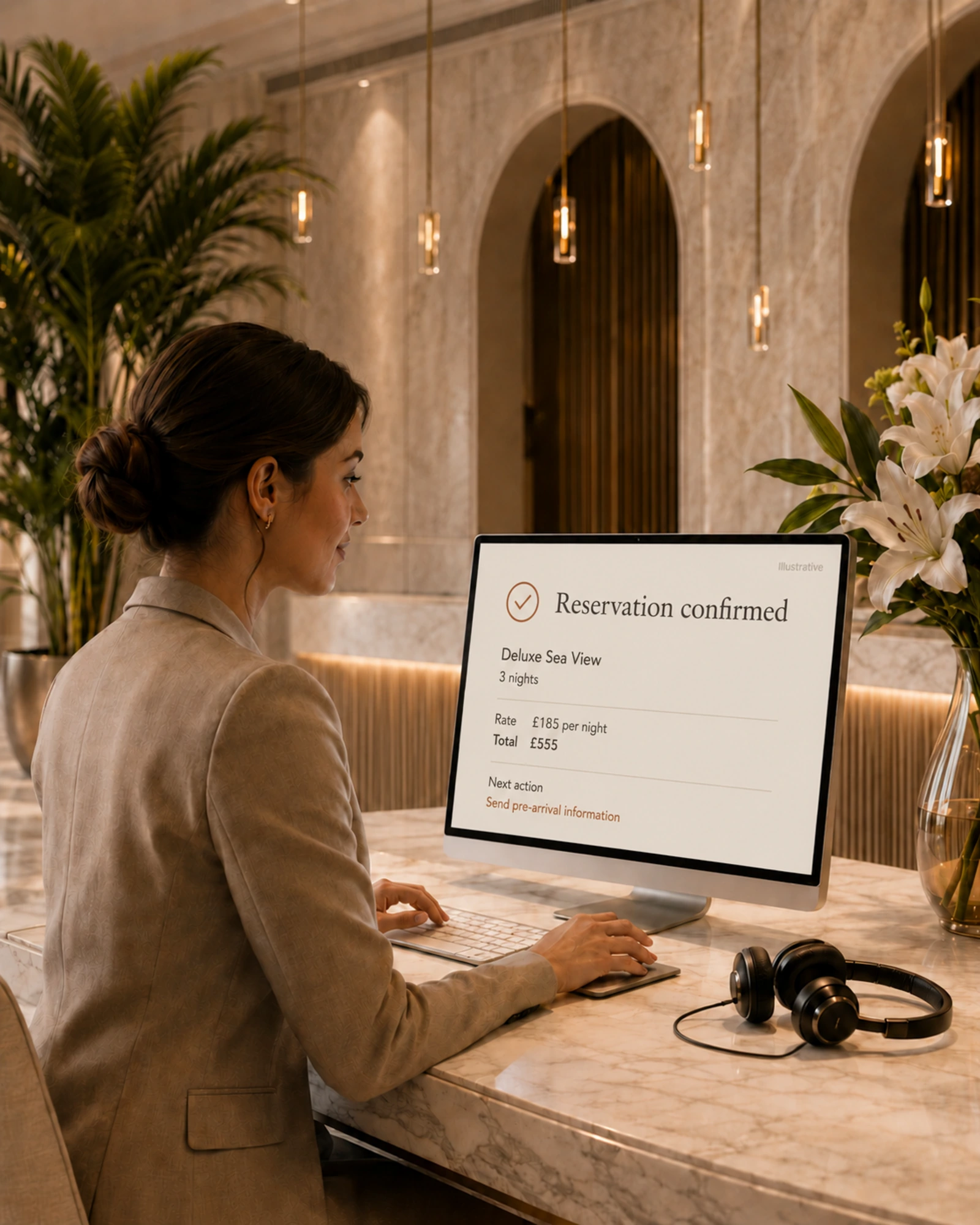
The period between confirmation and arrival is one of the most valuable and most neglected stages of the guest journey. A thoughtful pre-arrival message confirms details, reduces no-shows, and opens a natural conversation about how to improve the stay. When that contact is generic or absent, the hotel forfeits the easiest opportunities it will ever have to add value.
Strong pre-arrival contact tends to cover:
- A warm confirmation of dates, arrival time and any special requests
- A gentle, relevant prompt around room upgrades or added services
- Practical information that makes arrival smooth and reduces front-desk friction
The revenue here is twofold. Fewer no-shows protect the bookings already made, and timely, relevant offers can lift the value of each stay. The uplift is always subject to the property’s data, its market and how the contact is executed — but the opportunity is real and routinely left on the table.
Poor no-show handling and no upselling
No-shows are inevitable. Mishandling them is not. Where a clear process exists, no-shows are charged correctly in line with the rate, the room is released for resale where possible, and the pattern is reviewed for anything that can be improved. Where it does not, the room is lost twice: once to the guest who never arrived, and again because no charge was raised.
Upselling sits in the same category of missed, low-cost opportunity. Room upgrades, late checkout, early check-in, parking and packages are often available but rarely offered with any structure. A reservations function that treats upselling as a habit — offered consistently, at the right moment, in a way that genuinely suits the guest — turns existing demand into incremental revenue without spending a penny more on acquisition.
Where outsourced reservations management fits
The common thread across all of these mistakes is not a lack of care. It is the difficulty of applying consistent discipline, every day, with a small team carrying many responsibilities at once. Outsourced reservations management is designed to remove that fragility: cards charged on time, deadlines honoured, messages answered, pre-arrival contact made, no-shows handled correctly, and upselling offered as standard. It is performance-focused and evidence-led, built to protect revenue the property has already earned.
A useful first step is to see where the leaks are and decide who will own the correction. RevROI’s Commercial Growth Partnership combines reservations controls with the wider pricing and channel rhythm, with progress reviewed against the baseline agreed in onboarding. Discuss the Growth partnership.
The figures and ranges in this article are illustrative. Actual results depend on each property’s data, market conditions and implementation. The best way to understand your own opportunity is a senior conversation about the partnership depth your property needs.