

Insights
How independent hotels lose revenue without noticing
A clear look at the small, compounding ways independent hotels leak revenue every day — and how a commercial baseline brings them into view.
Most independent hotels do not lose revenue in a single dramatic moment. There is rarely a crisis to point to, no obvious failure that explains a softer-than-expected month. Instead, revenue tends to drain away quietly — a few pounds here, an unconfirmed booking there, a card that expired before anyone noticed. Each loss is small enough to overlook on any given day, which is precisely why it goes unaddressed. Over a quarter, and then a year, those small leaks compound into a figure that matters a great deal.
The encouraging part is that these leaks are rarely a sign of poor management. More often they are the natural consequence of a small team doing the work of a much larger one, with limited time to step back and examine the system as a whole. What follows is an honest look at where the money tends to slip away — and why it so often happens without anyone noticing.
Static pricing in a market that never stands still
Demand moves constantly: by season, by day of the week, by local events, by the weather, by what the property next door is doing. Yet many independent hotels set their rates a few times a year and leave them largely untouched. The intention is sensible — consistency feels safe, and frequent changes feel like a job no one has time for.
The cost of standing still shows up in two directions. On high-demand nights, rooms sell too early and too cheaply, leaving money on the table that can never be recovered. On quieter nights, rates sit too high for the real level of demand, and rooms go empty when a modest adjustment might have filled them. Neither outcome announces itself. The hotel was busy, or it was quiet, and the rate simply was what it was.
A more responsive approach does not mean chasing the market hour by hour. It means pricing that reflects genuine demand signals, reviewed on a sensible rhythm, so the rate is closer to right more often than not.
Over-dependence on the OTAs
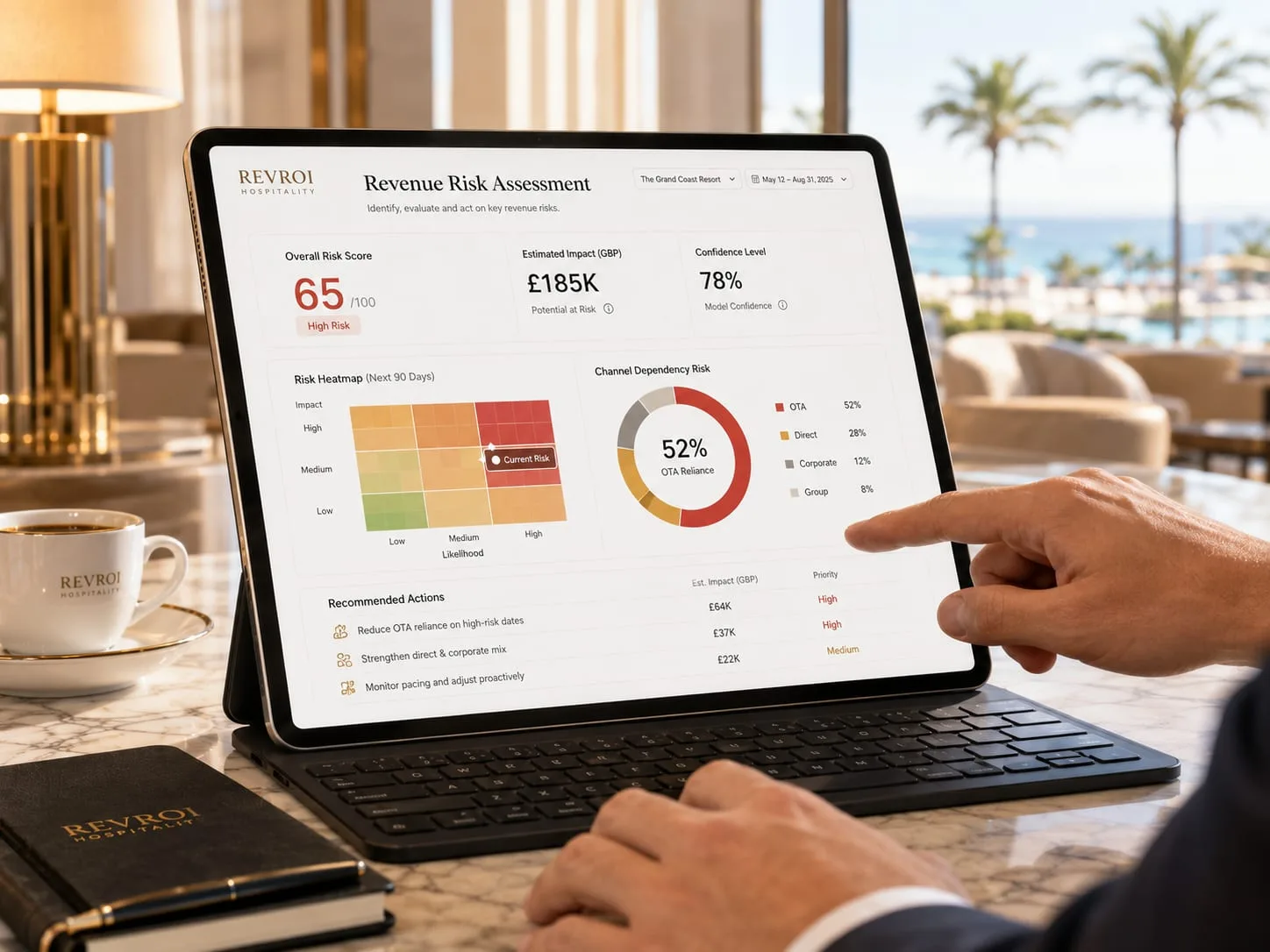
Online travel agents are valuable. They bring visibility and reach that an independent property would struggle to build alone. The difficulty begins when they quietly become the dominant channel rather than one channel among several.
The leak here is twofold:
- Commission that accumulates unnoticed. A booking through a third party is worth meaningfully less than the same booking made directly. Across hundreds of stays, the gap between the headline rate and what the hotel actually keeps becomes substantial.
- The guest relationship is held by someone else. When the first and last touchpoints belong to a platform, the opportunity to build loyalty, encourage a return visit, and capture direct bookings next time is diminished.
None of this argues for abandoning the OTAs. It argues for understanding the true cost of each channel and giving the direct channel a fair chance to compete — so the mix is a deliberate choice rather than a default that drifted into place.
Bookings that slip through the cracks
Some of the most avoidable losses sit in the everyday handling of reservations. They are operational rather than strategic, which can make them easy to dismiss — and easy to repeat.
- Unconfirmed or missed bookings, where an enquiry never converts because no one followed up in time.
- Expired virtual cards, where payment authorisation lapses before it is captured, and revenue that was genuinely earned is simply never collected.
- No-shows that are not protected by a clear policy, leaving rooms held and then empty with nothing to show for them.
Individually, each of these feels like an exception — a one-off, a busy shift, an unusual case. The pattern only becomes visible when the exceptions are counted together over time. That is the quiet danger of operational leakage: every instance has a reasonable explanation, and the cumulative total never appears on a single report.
Reporting that hides as much as it reveals
You cannot recover what you cannot see, and weak reporting is often the thread connecting every issue above. When the numbers live across disconnected systems — the booking engine, the channel manager, the payment provider, a spreadsheet or two — no single view shows the full picture.
The result is a hotel that feels its performance rather than measures it. Trends are noticed late. Underperforming segments hide inside healthy-looking totals. A channel that looks profitable on the surface turns out to cost far more once commission and cancellations are accounted for. Good instincts go a long way in hospitality, but instinct alone struggles to catch a slow leak. Clear, consolidated reporting turns vague unease into specific, addressable findings.
How a revenue audit brings the leaks into view
The common feature of every leak described here is that it is hidden in plain sight. Each one is small, reasonable in isolation, and spread across different parts of the operation — which is exactly why a structured review is so valuable. A revenue audit is simply the act of looking at the whole picture at once, with fresh and experienced eyes, and asking where value is being lost.
A considered commercial baseline identifies improvement opportunities by examining pricing behaviour, channel mix and commission, reservation handling, payment capture, and the quality of reporting that ties it together. Any target remains subject to the hotel’s data, market conditions and implementation—but the first step is visibility. Once a leak can be seen, it can be owned and addressed.
If any of this feels familiar, the useful next step is a clear-eyed conversation about where revenue is slipping away and whether a Commercial Revenue Opportunity Assessment, Commercial Growth Partnership or Commercial Intelligence Partner engagement is the right response. Talk through your property with RevROI.
The figures and ranges in this article are illustrative. Actual results depend on each property’s data, market conditions and implementation. The best way to understand your own opportunity is a senior conversation about the partnership depth your property needs.